True Power Lies in the Pause
“True power lies in the pause.”
In our relentless world of constant motion and endless striving, these words land like a gentle rebellion against everything we’ve been taught about success and achievement. In the radiant, geometrically complex world of the Thoth Tarot, The Hanged Man offers not suffering—but liberation.
Beyond the Illusion of Suffering
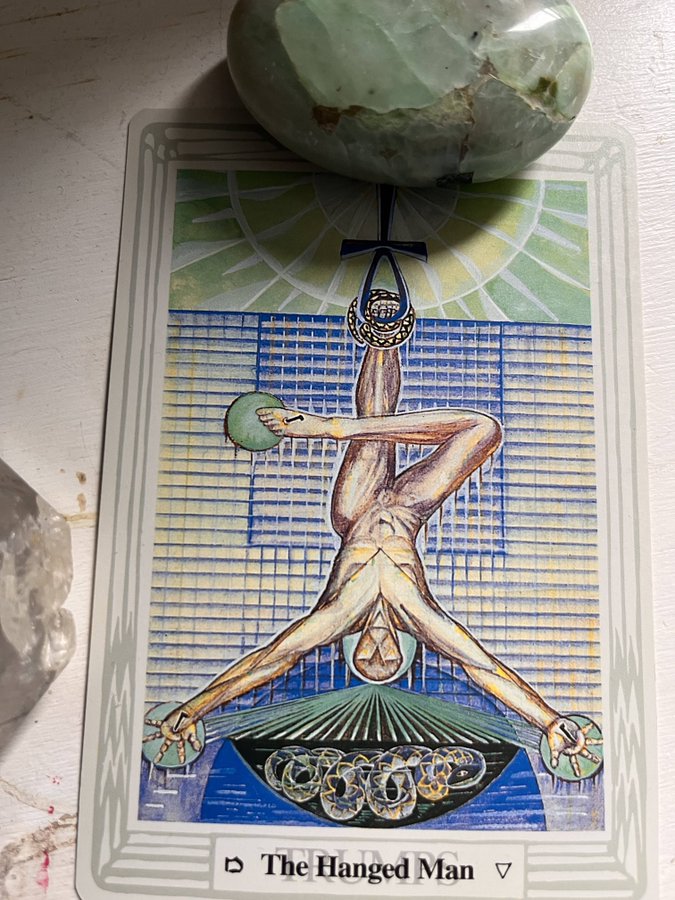
Unlike traditional images of agony or punishment, this card reveals a suspended figure in elegant inversion, arms outstretched, forming an alchemical cross. The figure isn’t tortured or defeated—they’re transformed. The card challenges our ingrained assumptions about movement, time, and control, asking us to consider: What if the very thing we resist is the key to our freedom?
The Hanged Man doesn’t hang as a victim of circumstance. They hang as a willing participant in their own metamorphosis, choosing suspension over struggle, stillness over force. In this voluntary surrender, they discover a profound truth: sometimes the most powerful thing we can do is nothing at all.
The Sacred Art of Letting Go
When this card appears in a reading, it’s a spiritual whisper carrying three essential messages:
🔹 Let go to grow – Like a tree that must shed its leaves to survive winter, we too must release what no longer serves us to make room for new growth. The Hanged Man teaches us that letting go isn’t about losing; it’s about creating space for transformation.
🔹 Release your grip to gain true sight – When we’re constantly grasping and controlling, our vision becomes narrow, focused only on what we think we need. In the pause, in the letting go, our perspective expands. We begin to see patterns we missed, solutions we overlooked, and possibilities we never imagined.
🔹 Stop striving, and allow truth to unfold upside-down – The Hanged Man’s inverted position isn’t accidental. It represents a complete shift in perspective. What appears as defeat to the world may actually be victory. What looks like stillness may be the most profound movement of all.
The Geometry of Surrender
In the Thoth deck’s intricate symbolism, The Hanged Man’s pose forms an alchemical cross—the intersection of spirit and matter, heaven and earth. This isn’t random positioning; it’s sacred geometry. The figure becomes a living bridge between worlds, suspended between what was and what will be.
The geometric patterns surrounding the card speak to the mathematical precision of surrender. Just as a pendulum must pause at the height of its swing before reversing direction, so must we sometimes come to a complete stop before we can move forward with true purpose.
Embracing the Pause in Modern Life
In our productivity-obsessed culture, the concept of purposeful pause feels almost revolutionary. We’re taught that movement equals progress, that stillness equals stagnation. The Hanged Man challenges this fundamental assumption, suggesting that true power—the kind that transforms rather than merely rearranges—comes from the courage to stop.
This pause isn’t passive; it’s profoundly active. It takes tremendous strength to resist the urge to force outcomes, to trust the process even when we can’t see the end result. The Hanged Man embodies this paradox: complete surrender that requires complete courage.
The Invitation to Inversion
When The Hanged Man appears in your life, whether through a tarot reading or simply as a metaphor for your current experience, it’s extending an invitation:
What if you stopped pushing and started allowing?
What if you trusted the pause instead of fearing it?
What if the very situation that feels like suspension is actually preparation for flight?
The figure in the card doesn’t struggle against their bonds—they dance with them. They’ve discovered that resistance creates suffering, but acceptance creates space for miracles.
Finding Power in Powerlessness
The ultimate teaching of The Hanged Man is that true power doesn’t come from our ability to control outcomes, but from our willingness to surrender to the flow of life itself. In that surrender, we discover that we were never meant to carry the weight of the world alone.
The pause isn’t punishment—it’s preparation. The suspension isn’t suffering—it’s sanctuary. And in that sacred space between action and outcome, between question and answer, between who we were and who we’re becoming, we find the profound truth that sometimes the most powerful thing we can do is trust the wisdom of simply being.
In the pause, we find our power. In the letting go, we find our way.