
Understanding the 8 of Swords: How to Overcome Mental Blocks and Find Your Power

How to Overcome Mental Blocks and Find Your Power
“The only thing that stands between you and your dream is the will to try and the belief that it is actually possible.” — Joel Brown
Welcome back to the blog! Today, we are diving deep into a card that often looks a bit scary at first glance, but actually holds a very empowering secret. We are talking about the 8 of Swords, which in the Thoth-style deck shown in the image, is titled “Interference.”
If you have ever felt like you were stuck in a “mental fog” or felt like you couldn’t make a decision no matter how hard you tried, this card is talking directly to you. Let’s break down what this card means and how you can use its lesson to improve your life today.
read more…Unleashing Your Inner Fire: Understanding the Lust Card

Understanding the Lust Card
Have you ever felt a surge of energy that made you feel like you could take on the world? That intense, joyful “spark” is exactly what the Lust card is all about. While the name might make you think of romance, in the world of the Thoth Tarot, this card—numbered XI—is actually about something much bigger: your life force, your courage, and your creative power.
In many other tarot decks, this card is called “Strength.” However, the Lust card adds a layer of excitement and ecstasy. It shows a woman riding a powerful, multi-headed beast. She isn’t fighting the beast or trying to hurt it; she is guiding it with love and confidence. This is a huge lesson for us in our daily lives. It tells us that we don’t need to “tame” or hide our big emotions. Instead, we should learn to ride them!
read more…When the Pause Is the Progress

When the Pause Is the Progress
Sometimes the most frustrating season is the one where you’re doing “all the right things”… and still nothing is moving.
You pull The Hanged Man (XII) and it feels like the universe just shrugged.
But The Hanged Man isn’t a punishment card. It’s an initiation. And with a green stone placed on the card—right over that upper-right quadrant—it becomes an even clearer message:
This is a heart-led pause. Not a dead end.
read more…Love Doesn’t Need More Thinking—It Needs a Next Step

There’s a specific kind of stuckness that doesn’t look like stuckness.
It looks like:
- “We’re good… we just haven’t talked about it.”
- “I’ll reach out when things calm down.”
- “We’ll plan something soon.”
- “I don’t want to push it.”
And then days become weeks. Weeks become a vibe. The vibe becomes a habit.
If you pulled Surrender Procrastination alongside the Two of Cups (Love), here’s the message in plain language:
The connection has potential—but it’s waiting on a real move.
Not a perfect move. Not a dramatic move. A simple, honest move.
read more…The Gift in the Rubble: Understanding The Tower (XVI) in the Thoth Tarot
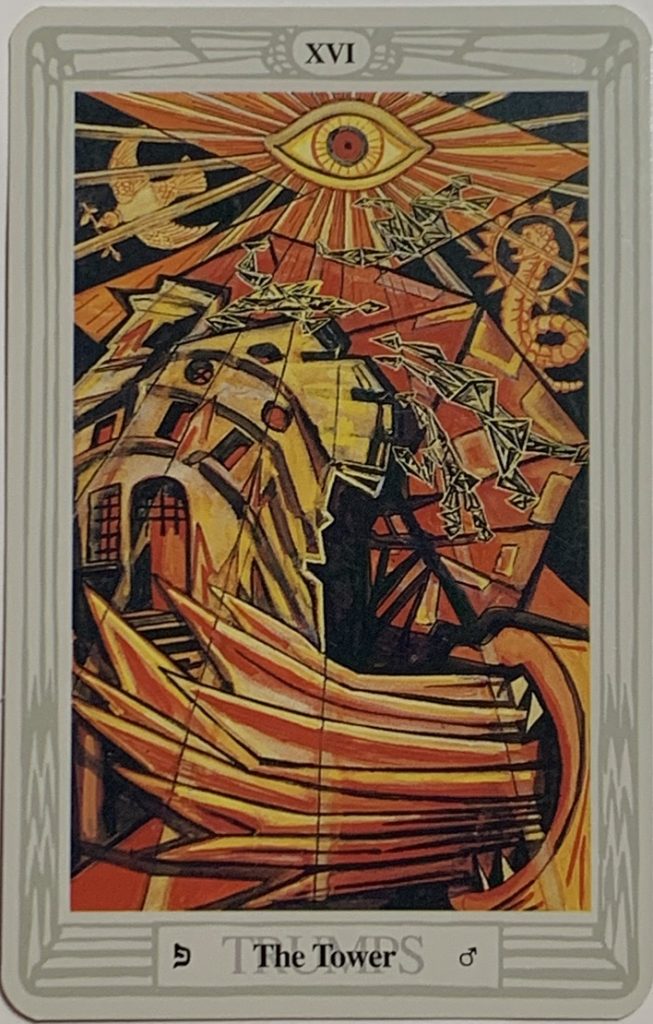
The Tower is the moment the universe kicks the door in.
In the Thoth Tarot, XVI – The Tower is a violent, almost explosive image. A jagged structure buckles and shatters. Lightning rips through the scene. An all-seeing eye blazes at the top, radiating beams of fierce awareness. A dove and a serpent hover in the chaos, while geometric human forms seem to be blown apart.
It looks like disaster. But underneath the drama, The Tower is about something far more radical: the mercy of truth.
This is the card that appears when what you’ve built—beliefs, identities, relationships, careers, coping mechanisms—can no longer house who you’re becoming. The structure isn’t evil; it’s just too small. So life, in its blunt cosmic wisdom, shakes it down.
read more…When Death Becomes the Teacher: Transforming with XIII & V in the Thoth Tarot

Death & The Hierophant: When Endings Become Initiations
When we draw XIII – Death and V – The Hierophant together in the Thoth Tarot, we’re not looking at doom and dogma. We’re looking at a radical initiation: the death of an old self, and the apprenticeship to a deeper inner teacher.
These two cards side-eye our comfort zones. One asks, “What are you willing to let die?” The other asks, “And who are you willing to become under a higher guidance?”
Let’s walk through them.
read more…Dawn of the New Aeon: Unveiling the Mystical Power of Tarot’s XX – The Aeon

The Phoenix Rises: Decoding the XX – The Aeon Tarot Card
The card you have is not the familiar Judgement, but its powerful, esoteric counterpart from the revered Thoth Tarot Deck: XX – The Aeon. Cradled beneath the beautiful, iridescent opalite, this card heralds one of the most significant shifts in the entire Major Arcana.
While the traditional Judgement card focuses on a final, external verdict and resurrection, The Aeon (meaning “Age” or “Era”) invites a profound, internal reckoning and a dramatic, evolutionary leap in consciousness. This is not the end of the world—it’s the unveiling of a new one.
read more…Unleashing the Surge: The Dynamic Energy of the Eight of Wands

The Dynamic Energy of the Eight of Wands
The Eight of Wands, often dubbed “Swiftness” in tarot decks like the Thoth Tarot, is a card that crackles with energy, motion, and rapid transformation. Picture eight wands soaring through the air, cutting through the skies with purpose and momentum. This card embodies the exhilarating rush of progress, the spark of sudden inspiration, and the unstoppable force of change. Whether you’re a seasoned tarot reader or just dipping your toes into the mystical waters, the Eight of Wands has a vibrant message to share. Let’s dive into its meaning, symbolism, and how it might speak to you in a reading.
read more…The Clarity of the Ace of Swords

Cutting Through the Clouds: The Clarity of the Ace of Swords
The Ace of Swords arrives like a flash of lightning—piercing through confusion, illuminating truth, and clearing the mental fog that’s been hanging heavy. In the Thoth Tarot, this card bursts with energy and brilliance: a sword rising from the clouds, crowned by light, symbolizing the pure potential of the mind when aligned with clarity and truth.
This is a card of awakening thought. It represents mental breakthroughs, new ideas, and a fresh perception of reality. The Ace of Swords doesn’t whisper—it declares. It calls you to cut away illusion and face things as they are, not as you wish them to be.
read more…